User's guide
Tasks
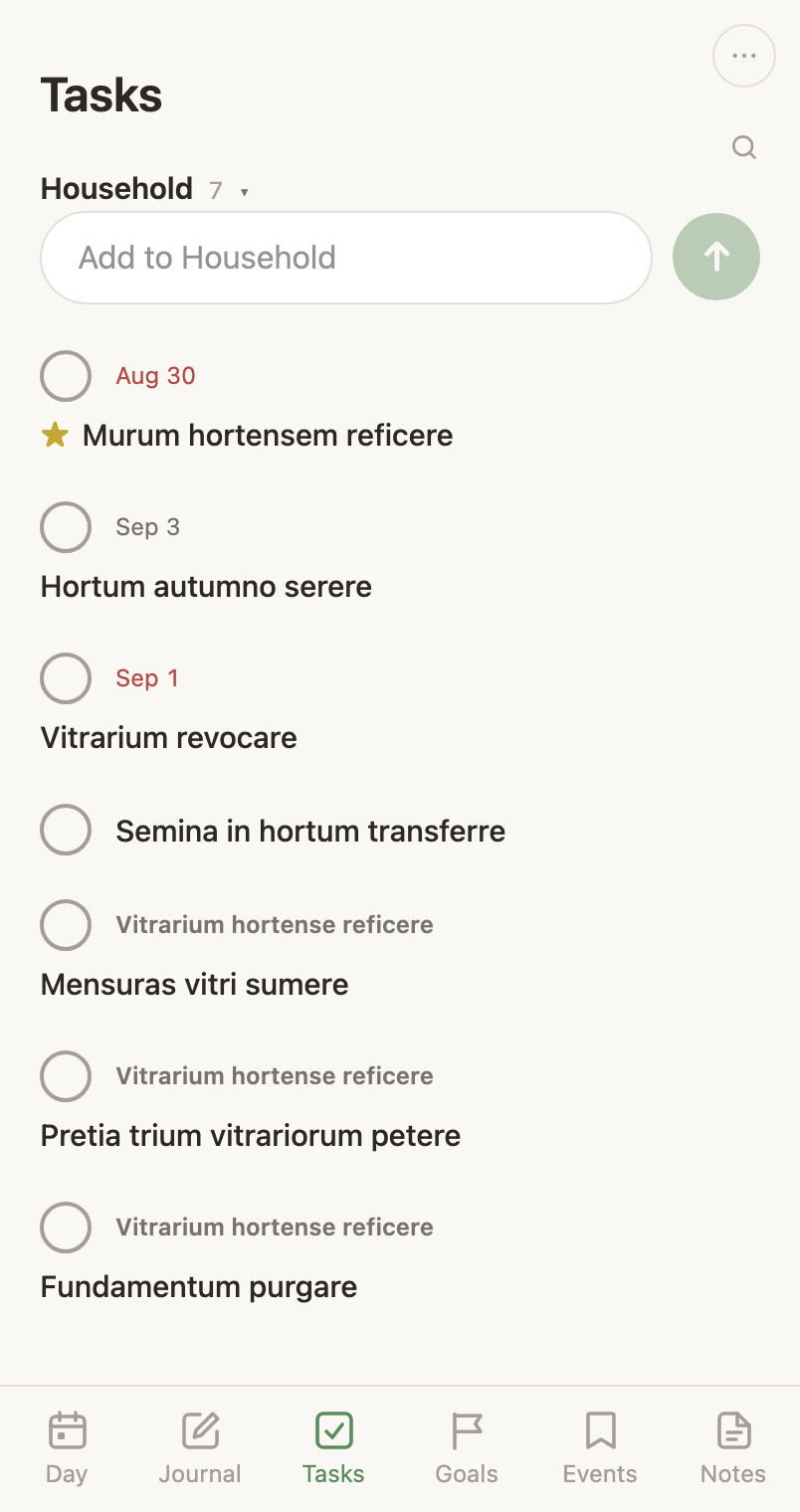
Tasks holds everything you have open, grouped into your life areas. You check things off with a tap, add new ones from the bar, and open any one of them to change or remove it.
Your areasYour tasks are grouped by life area
One line names the area you're in, with a count of what's still open in it. Tap that line and a sheet lists every area, each with its own count, along with a field to narrow a long list of them. Pick one and the tasks below change. A task you add belongs to the area you're looking at, and tasks with no area are under General. On a wide screen the areas are a column down the left instead. That column lists the areas with something open in them, plus whichever one you are in, and All areas under them raises the same sheet, with every area on it and the field to narrow them.
You do not have to file a task yourself. With AI on, an open task with no life area is filed under one of yours within a few minutes, read from the task’s own words. A task that belongs to a goal takes that goal’s area instead, with no model asked at all, so that part holds even with AI off. Set the area yourself on the task’s page and your pick stands; clear it there and it stays clear.
Tap the ring beside a task to complete it. It fills in and the words strike through, and the task stays put for a second and a half before fading off the list — long enough to see what you cleared, and to tap the ring again if you did it by mistake. On the advanced tier the status pill does the same job: picking a finished status strikes the row and it leaves the same way. Show finished at the bottom of the list brings back everything you completed, drawn as the same rows the list above uses. The ring beside a finished task reopens it. On the advanced tier its status pill does that instead. The bar above the list adds a new task to whichever list you're looking at.
A task has a page of its own, and it is the only place a task is edited. It holds every field the task has, room to write, its subtasks under that, and the notes you have written against it. In a browser its words open it, and so does the rest of the row; on the phone a tap opens it, and so does a press and hold. A task’s page covers what is on it.
In a browser, right-click a task, or press and hold it on a touchscreen, and its menu opens:
- Mark done — completes the task, the same as tapping its ring on the simple tier, or picking a finished status on its pill on the advanced one. On a task already finished this item reads Reopen.
- Set status… — pick one of your own status words for it. It comes with Goals & task detail.
- Details… — the task's own page, which the row itself also opens.
- Decline — only on a meeting mirrored from your calendar. It answers no in your calendar there and then, and the task behind the meeting closes as cancelled.
- Remind me… — a nudge about this task at a time you pick.
- Top priority today — stars the task, and a starred task sorts first in whatever list it is in. The star holds until you finish the task or press it again, so a priority you did not get to is still a priority tomorrow. On a task already starred this item reads Not top priority.
- Make this a goal — turns the task into a goal, for work that grew past one line. It comes with Goals & task detail.
- Hide until tomorrow — the task is off the list until morning. It comes with Goals & task detail.
- Delete — removes the task for good, after a confirm.
The installed phone app has no such menu. There a tap and a press-and-hold both open the task's page, and the same moves are on it: the star, Hide until tomorrow, Make it a goal, Remind me, Not going on a meeting, and Delete. Finishing a task there is the ring or the status pill on the row, the same as on the web.
Finding oneSearch when you don't know the area
The magnifier in the top corner finds a task by its words, wherever it is filed. The usual reason to hunt for one is that you forgot which area you put it in, so the search reads every area at once, and your notes and your days with them. A finished task comes back too, since a search is a question about what you wrote rather than about what is still open. Search covers what to type and how to read what comes back.
More detailA switch in Settings gives tasks statuses and more views
A switch in Settings → Tasks called Goals & task detail gives each task a status you named and a type, adds Status and Date views of this list, and fills in the Goals tab beside this one. The type picker on a task's page offers the types already on your tasks, busiest first, and narrows as you type. It picks from those words. A type you have never used is not named there; a goal's kind is the field that takes a new word.
The Status view leads with Today, above your own status words. What is dated today reaches it, along with what you starred for today and what you added today. A meeting drops out of it once its time has passed. The section is worked out each time you look, from the task’s date, its star or its age, so a task goes when those change.
The Areas view is divided inside as well. An area whose tasks disagree about where they stand is split under your status words, and one that agrees on that and is mostly dated is split into the same day bands the Date view uses.
The add bar stands above the Areas and Status views. Every heading naming one of your statuses has a + beside it, which aims the bar at that pile. The Date view has no standing bar, since a task typed under a day you are not in gets the wrong date. The + on its Today and Top priority today headings is what raises one there. Show finished appears under the Areas view. Off, Tasks is the simple checklist the rest of this page describes. Goals & task detail covers everything it changes.