User's guide
Journal
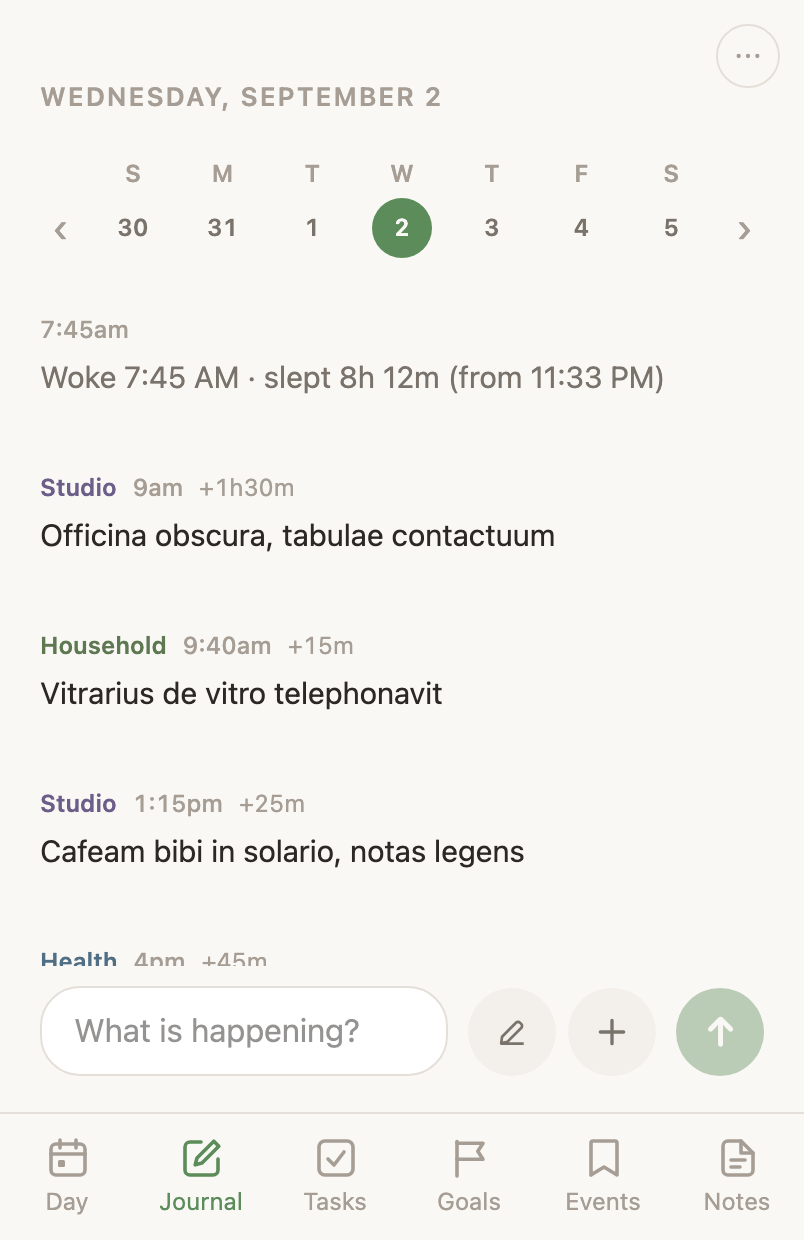
The Journal is a running log of your day. You type what's happening, it appears on a timeline at the moment you wrote it, and you read the day top to bottom.
Writing an entryYou type in the bar and send it
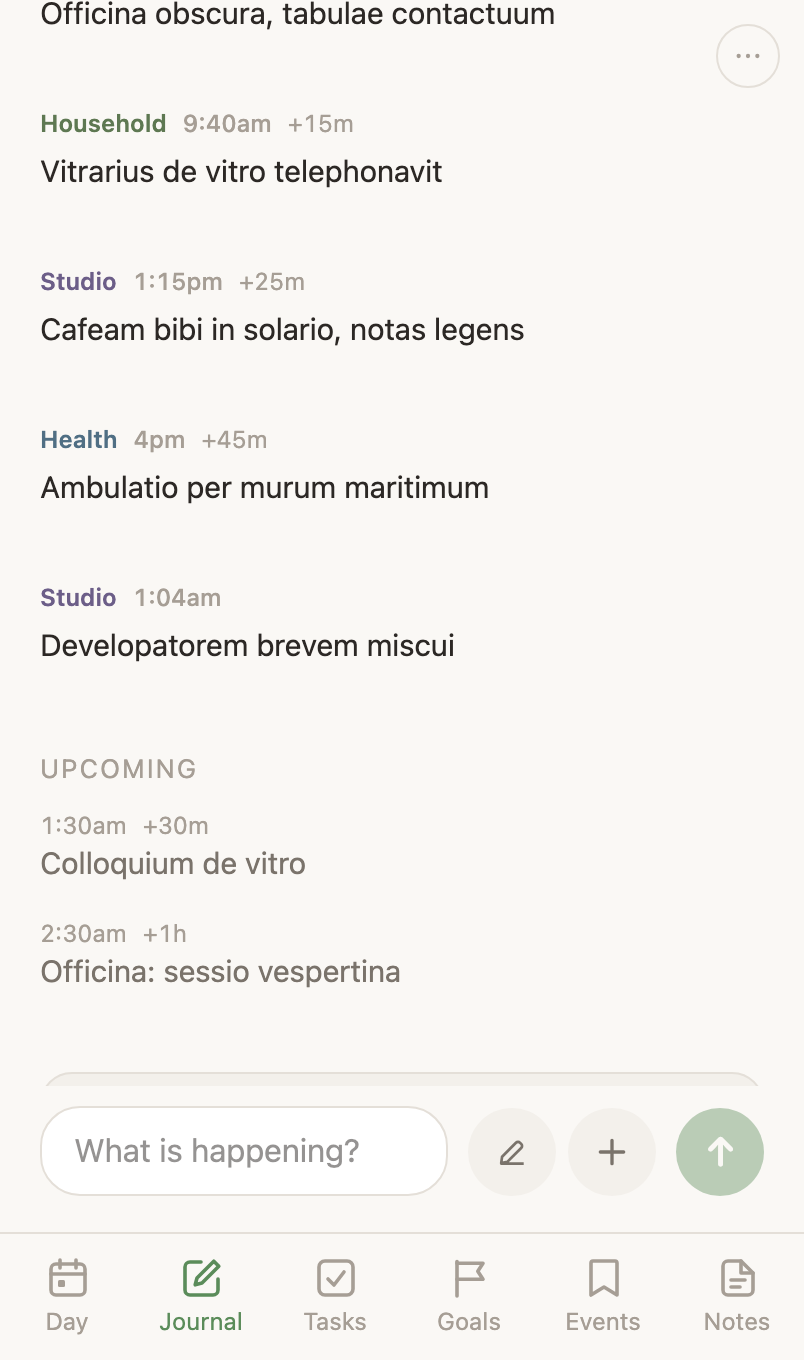
The bar at the bottom reads What is happening? Type an answer and tap the arrow, or press Enter. The entry appears in the day's feed stamped with the current time, and the bar clears for the next one. Your meetings appear in the feed at their times too, with the rest of today's under Upcoming. An all-day item has no time of day to appear at, so it stays off the feed. Hold one (right-click on a computer) for the three words the Day uses. Going marks that you plan to attend, and a meeting still ahead of you then says Going beside its time. Done turns it into a time log with its real title and times. Decline asks first, then takes the meeting off the day and answers no in Google without emailing anyone, with six seconds to Undo before anything is written. A meeting you declined in Google never reaches the feed at all. Leaving the day or closing the tab sends the decline early. If the server refuses it then, the app names the meeting and says it is still there. It says so the moment you are looking at that screen again, or on the next load of that day when the screen has gone for good.
Hold the arrow for about half a second instead and a clock appears above it. Keep your finger down. Letting go while still on the arrow counts as a tap on the arrow, which saves the words as an ordinary entry and takes the clock away. Slide off the arrow before you let go and the clock stays where it is. Then tap the clock, and the same words start a time log, an entry that keeps counting until you tap its Stop. One runs at a time, and the clock is offered on today only.
Above each entry's words is one caption line: the life area it belongs to, in its own colour, then the time, then the goal it was written against when it has one. That goal name opens the goal’s page, on the phone as well as in a browser. An entry saved without a time still says when. Written on the day it is filed under, it shows the clock it was posted at. Written on some other day, it shows that posting date, Jun 4. A time log adds how long it ran, +29m, and one still running shows a count that climbs with Stop beside it. With the AI on, the app picks the area for you, so a quick entry stays a quick entry. Pick the areas yourself and your pick stands. Entries marked Agent were written by your Claude — a conversation logged, or a note taken on your behalf. Your Claude is the agent that works alongside whoever runs your LifeOps. What your devices report, and what the app records for its own bookkeeping, stay off this feed and out of search; both appear on your Day under System instead.
The strip of week days above the feed opens any day in the week it shows, and the arrows either side move a day back or forward. Step off either end and the strip follows to the week your new day is in. Hold a day, or right-click it on a computer, and the whole month opens under the strip for a date further off. Today is one tap away when you leave it. On an earlier day the bar reads Add a note to Friday instead, and an entry you add there saves untimed, since it belongs to that day rather than to this minute. Untimed entries collect below that day's timed ones, in the order you wrote them.
Longer entriesTap the pen to write an entry longer than one line
The pen on the writing bar opens a composer for an entry longer than one line. The cursor starts in the entry rather than the title, on both surfaces, so you write first and name it after. Write as much as you want and save it. It appears in the feed like any other entry. The pen stands on the bar itself, beside the + that attaches things, on the phone and in the browser alike, so it is under your hand mid-sentence rather than at the far end of the screen.
Give it a title and it becomes a document as well, a page you can reopen and keep working on, with the journal entry pointing back to it. Leave the title blank and it stays a plain, longer entry. Either way it appears on the timeline at the time you wrote it.
A titled entry shows as a card in the feed. Tap the card and its document opens, on the phone as well as the web, and you type into it where it stands. A document with headings or lists edits on the phone one line at a time, and new writing goes on the end as a paragraph. The web is where you change the headings, the lists, and the order they come in. Every document is also on its own tab, Notes, which lists all of them and is where you start new ones.
Finding an entrySearch is a corner magnifier, not a Journal tool
You remember the words, rarely the date. Search reads every day you have ever written on, and everything inside your notes with it, so it is not on this header. It is the magnifier in the top corner, beside the chat bubble and the gear, in the same place on a wide browser window, on a narrow one, and in the phone app. Search covers what to type and how to read what comes back.
Photos and recordingsThe plus button beside the bar records straight into the feed
The + button beside the bar opens everything you can add to the day. A browser offers Record video, Record a voice memo, Record screen, and Photo, video or audio file… from your device. The phone offers Record a video, Record a voice memo, Take a photo and From the library, since it has its own camera and no screen to record. On the phone the send button itself is a second way in: with nothing typed it shows a camera and records a video, and holding it there offers a voice memo instead.
A recording posts itself the moment you stop it, since making the recording is the act of writing the entry. A photo or a picked file waits above the bar instead, as a thumbnail with an ✕ to take it back off, and the arrow sends it with whatever you have typed by then, so a photograph goes up with the sentence about it.
Record a voice memo records with no camera at all, for an update you don't want your face in. It is on both the web and the phone. The red clock and the level bar stand in for the preview a video gets, and they are what show it running. It posts the way a video posts, and an entry with a voice memo in it plays where it sits.
The app's own recorder starts rolling the moment it opens, and the red clock shows it is running. A level bar shows your voice registering on the mic and warns you in red when it goes silent, so a dead mic is visible before you lose a take. In a browser that recorder uses the machine's camera and mic, and pickers choose between them when you have more than one, with the choice remembered for next time. On the phone the app's recorder is the voice memo one, and Record a video or Take a photo hands you to the phone's own camera instead.
A take is saved on your device before it uploads. An upload that fails reappears, even after a restart, with Retry to send the same take. Save file in the browser writes that take to disk, and Save on the phone hands it to the share sheet, so the recording is out of the app before anything else happens to it. Discard deletes the only copy, so it always asks twice.
Anything longer than one piece posts with a percentage, and once the rate has settled the line adds how long is left, about 5 minutes. Stop beside that line ends the send, on the phone and in a browser alike. The recording stays where it was, with Retry beside it, and Retry sends the whole thing again from the first piece rather than from where you stopped it.
A video picked from the library on the phone goes up as a smaller 720p copy, so an hour of camera footage is a send you can finish. The row above the bar says what that copy weighs, and what posting it will cost once a send has measured your connection. Full size beside it reopens the library to pick the same video untouched. The smaller copy is made on the way out, so nothing in your library changes either way.
A recording can be transcribed. Switch Transcribed recordings on in Settings → Features and a video or a voice memo you post comes back with a title and a short summary as its words on the timeline. Tapping them opens the full transcript in its own reader. Anything you typed beside the recording is kept as written, and the transcript lands underneath it. With the feature off, a recording is saved and plays, and nothing is sent anywhere. A video is compressed in the background either way, which keeps the storage bill down and makes a file a browser can play out of one a phone camera wrote.
Where those files go, what protects them, and which outside services receive a recording is spelled out in the owner's guide, under Your videos and photos.
Fixing an entryEach entry has a menu for small corrections
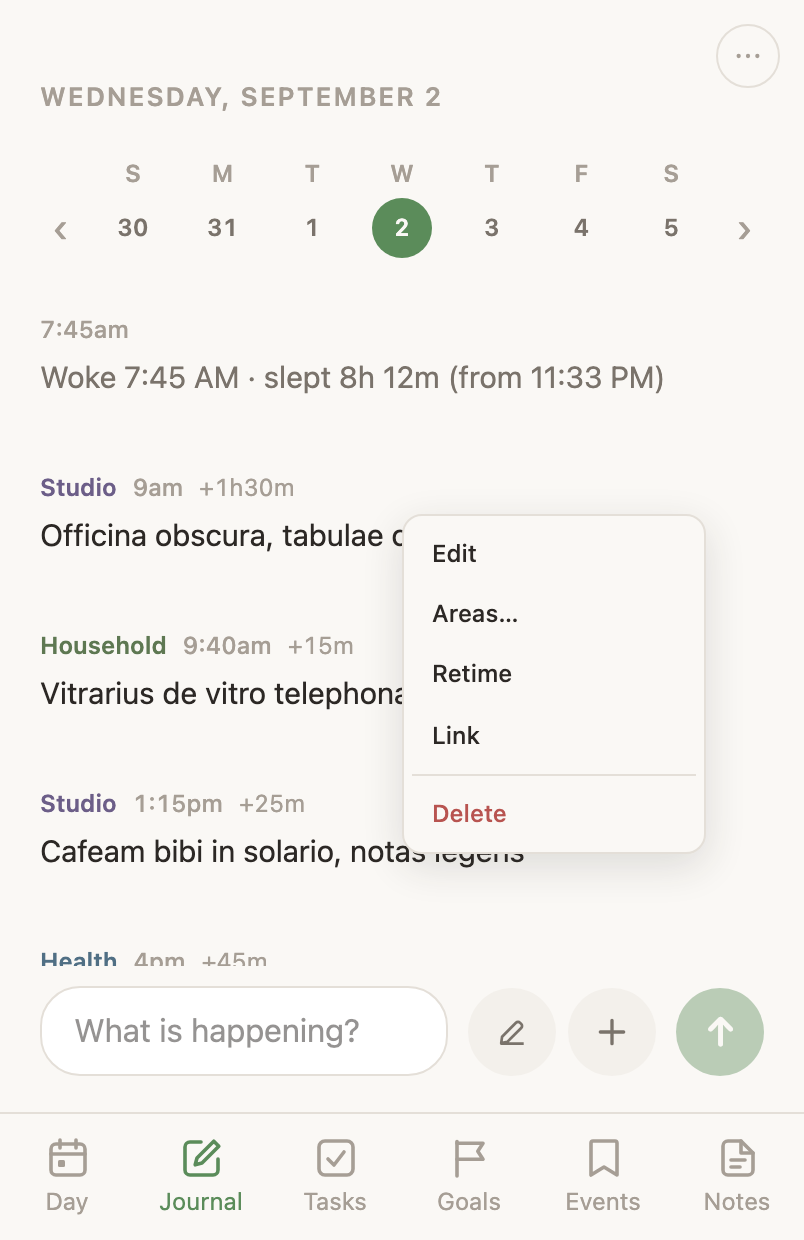
Right-click an entry on a computer, or press and hold it on a touchscreen or the phone, and its menu opens:
- Edit entry — change the words. A long-form entry has no Edit here. Its words belong to its document, so the phone offers Open document in that slot instead, and a browser opens the same document from the card in the feed.
- Areas — pick the life areas the entry belongs to, with the first pick setting its colour. Your pick replaces the app's. The app files an entry once and never asks about it again, so areas you clear stay cleared.
- Retime — move the entry to a different time on the same day. Nudge it by five minutes or an hour and save, and the feed re-sorts to match.
- Link to task — attach one of your open tasks. The entry then gets that task's area, so your log and your work line up. On a linked entry the item reads Change linked task, to link a different task or unlink it.
- Delete entry — remove it, after a one-tap confirm. The feed then shows Entry deleted. with Undo for six seconds, and Undo restores the entry whole: words, time, areas, and link.
- Transcript — on recorded entries only. It opens the recording's words in their reader.
- Write this up — on a recording that has no transcript. Use it when the recording missed its pass, which happens when the feature was off at the time, no key was stored yet, or the transcription failed once.
- Correct sleep — on the morning sleep reading only. It replaces what the app read, and Last night's sleep has the details.
The phone's sheet holds the same list in slightly longer words: Edit entry, Areas, Retime, Link to task or Change linked task, and Delete entry.
Last night's sleepEach morning the app posts an entry with last night's sleep
Some time each morning an entry appears in the feed reading Woke 9:00 AM · slept 12h 18m (from 8:42 PM) — the sleep reading. You write nothing to get it. The app works the night out from what you already left behind. It appears at the hour it has you waking, so it shows at the start of today rather than the end of yesterday. The night is filed under the life area you chose for it under Sleep in Settings, on a computer's browser, and under no area at all until you choose one.
The night is the gap between the last proof you were awake and the first proof you were awake again. Proof means something only an awake person does: a line you wrote in the journal, your phone joining the home network, a car stereo pairing with it. The app takes the longest quiet stretch that could be a night, at least three hours and at most fourteen, so a silent evening over dinner never counts as one. The device half of that proof works only after a small setup on each device, done by whoever runs your LifeOps. Until then the reading works from your journal lines alone. Your calendar says what was meant to happen. A meeting stays on it whether or not you got up that morning, so the app takes none of it as proof.
Some mornings the entry reads Woke by 2:10 PM · slept under 12h 18m instead, with no (from …) after it. The word under marks a waking the app never saw. When the first sign of you comes at eleven in the morning or later, that mark is not your waking. It is the first thing you happened to leave behind in a day you were already up and living in. You woke some time before it, so the span is a ceiling, and the entry says under instead of printing a number nobody measured.
Some mornings it is wrong. A home network dropping at 1:35 AM leaves the same trace as a person getting up, and the entry then reports a 1:35 AM waking. Correct sleep, in the entry's menu, is the fix: say when you woke and fell asleep, and the app recomputes the span, rewrites the sentence, and moves the entry to the corrected waking. The corrected entry reads like any detected one. The correction is kept inside the stored reading, and no later run of the detector replaces it.